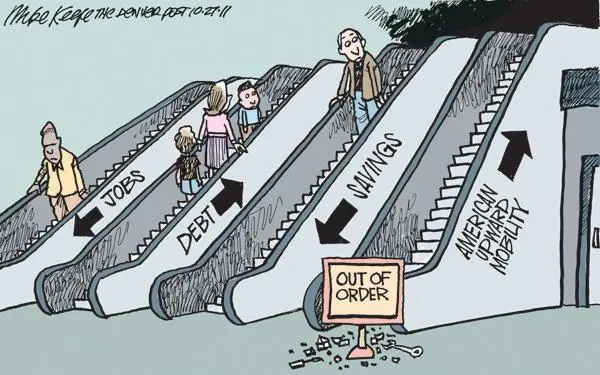
For generations, upward mobility was the defining promise of American life. Each generation expected to do better than the one before it. Hard work, education, and perseverance were believed to be enough to climb the economic ladder. But today, that ladder is missing rungs. The path upward is steeper, narrower, and more fragile than it has been in decades.
The decline of upward mobility is not the result of individual choices. It is the product of structural forces—economic, social, and policy-driven—that have reshaped the landscape of opportunity. Understanding these forces is essential to rebuilding a system where progress is possible again.
What Upward Mobility Really Means
Upward mobility is often reduced to income growth, but true mobility is multidimensional. It includes:
- Income mobility: Earning more than previous generations.
- Wealth mobility: Building assets that create long-term stability.
- Educational mobility: Access to higher-quality education and skills.
- Geographic mobility: The ability to move to opportunity-rich areas.
- Occupational mobility: Advancing into higher-paying, higher-skilled roles.
For much of the 20th century, these forms of mobility reinforced one another. Today, they often work in reverse—each one constrained by rising costs, stagnant wages, and structural barriers.
1. Housing: The First Rung Is Missing
Homeownership has long been the cornerstone of wealth-building in America. But the housing market has shifted dramatically. Limited supply, restrictive zoning, rising construction costs, and investor competition have pushed prices far beyond what middle-income families can afford.
Renters face similar challenges. In many cities, rent increases have outpaced wage growth for more than a decade. When families spend 30–50% of their income on housing, mobility becomes nearly impossible. Saving for emergencies, education, or retirement becomes a luxury.
Without access to stable, affordable housing, the first rung of the mobility ladder is out of reach.
2. Education: The Mobility Engine That Became a Debt Burden
Education was once the most reliable path to upward mobility. But the cost of college has risen dramatically, leaving millions of students and families with significant debt. Tuition inflation has far outpaced income growth, and the return on investment varies widely depending on field, institution, and geography.
For many, the promise of education has been replaced by the reality of long-term debt. Instead of accelerating mobility, student loans often delay homeownership, family formation, and retirement savings.
3. Wage Stagnation vs. Productivity Growth
One of the most significant structural shifts is the divergence between productivity and wages. Productivity has risen steadily for decades, but wages for most workers have remained relatively flat. This disconnect means that even as the economy grows, the benefits are not broadly shared.
When wages stagnate while costs rise, mobility stalls. Families work harder but feel like they are running in place.
4. Healthcare Costs and Financial Fragility
Healthcare has become one of the largest and most unpredictable expenses for American families. Premiums, deductibles, and out-of-pocket costs have all increased. Even families with employer-sponsored insurance face significant financial risk.
Medical debt is now a leading cause of financial hardship. A single unexpected medical event can derail years of progress. Healthcare inflation acts as a hidden tax on mobility, consuming resources that could otherwise support savings, education, or investment.
5. Decline of Stable, Long-Term Employment
The labor market has shifted from long-term, stable employment to a landscape defined by gig work, contract roles, and frequent job changes. While flexibility has increased, stability has decreased. Benefits such as pensions, healthcare, and predictable career ladders have eroded.
Workers now bear more risk than ever before. Career advancement is less linear, and income volatility makes long-term planning difficult. Without stability, mobility becomes fragile.
6. Wealth Concentration and Market Consolidation
Economic power has become increasingly concentrated. Fewer companies control larger shares of their industries, reducing competition and limiting wage growth. Wealth accumulation at the top has accelerated, while wealth-building opportunities for the middle class have diminished.
When wealth becomes concentrated, mobility becomes constrained. The ladder narrows, and fewer people can climb it.
The Geography of Mobility: Opportunity Depends on Where You Live
Upward mobility varies dramatically by region. Some areas offer strong schools, robust job markets, and affordable housing. Others offer few pathways upward. But the regions with the most opportunity are often the least affordable, creating a paradox: people are priced out of the very places that could help them advance.
Geographic mobility—once a hallmark of American progress—has declined. Families are less able to move to opportunity-rich areas due to housing costs, childcare expenses, and job instability.
The Psychological Impact: When Effort No Longer Feels Enough
The decline of upward mobility is not just economic—it is emotional. Middle-class families feel like they are doing everything “right” and still falling behind. This creates stress, anxiety, and a sense of instability that affects work, relationships, and long-term planning.
When effort no longer reliably leads to progress, trust in institutions erodes. People internalize systemic failures as personal failures, even when the barriers are structural.
Why Traditional Advice No Longer Works
For decades, the formula for mobility was simple: work hard, save money, get an education. But the system has changed faster than the advice. Today:
- Working hard does not guarantee wage growth.
- Saving money is difficult when costs outpace income.
- Education is more expensive and less predictable in its return.
- Housing is less accessible.
- Healthcare is more volatile.
Financial literacy alone cannot overcome structural barriers. Mobility requires both individual effort and systemic support.
What Would Rebuild Mobility? Structural Solutions
Rebuilding upward mobility requires addressing the systems that shape economic life. Several reforms could help restore the ladder:
1. Expand Housing Supply
Zoning reform, incentives for starter homes, and infrastructure investment can help close the housing gap. Without more supply, affordability will remain out of reach.
2. Modernize Education and Reduce Debt
Expanding vocational pathways, reducing tuition inflation, and improving student loan structures can make education a mobility engine again.
3. Strengthen Wage Growth
Policies that support competition, worker mobility, and productivity-linked compensation can help wages catch up to economic growth.
4. Reform Healthcare Costs
Greater transparency, cost controls, and employer innovation can reduce the financial burden on families.
5. Rebuild Retirement Security
Automatic enrollment, auto-escalation, and simplified retirement plans can help workers save more consistently. Social Security modernization—such as expanding taxable wages or adjusting benefit formulas—will also play a critical role.
6. Reduce Complexity Across Systems
Simplifying taxes, financial products, and public benefits can help families navigate the system more effectively. Complexity is a hidden barrier to mobility.
Conclusion: Mobility Is a Design Choice
The decline of upward mobility did not happen by accident. It is the result of decades of economic shifts, policy decisions, and structural changes. But mobility is not gone—it is simply constrained. With clarity, courage, and long-term thinking, leaders can rebuild the systems that once made upward mobility a defining feature of American life.
The American Dream is not dead—but it needs renovation.